




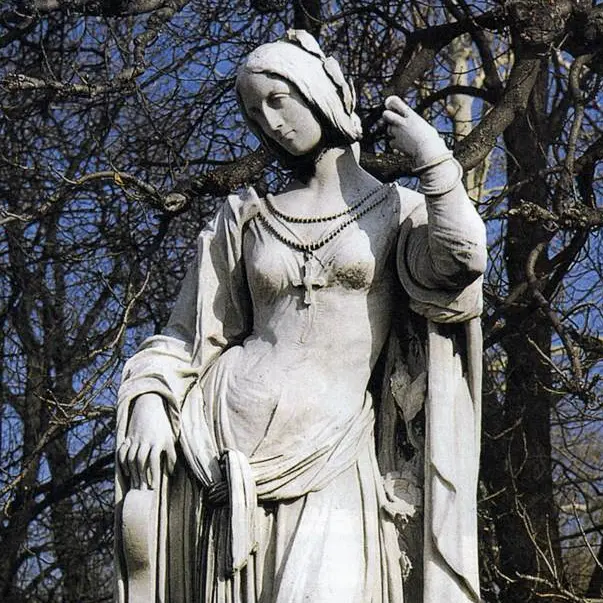
In order to revitalise and unite the national consciousness, Louis-Philippe, King of the French from 1830 to 1848, wished to pursue a deliberate policy of highlighting the country's history and the great figures who had embodied it. With this in mind, in 1837 he created a Museum of French History within the Château de Versailles, to illustrate and exalt the national memory.
Another of his lesser-known initiatives was the commission, in 1843, of a series of twenty statues on the theme of famous women, to adorn the gardens of the Palais du Luxembourg in Paris, around a building erected by a famous woman.
Twenty sculptors were selected, and a few years later they delivered works that interest us in more ways than one. Firstly, the choice of personalities to be enshrined in statues says a lot about the exemplary status of women as it was understood at the time. Of the twenty figures, ten are queens and two are regents of France. Most lived in the Middle Ages or the Renaissance, while three are from the 17th century. The nature of the sculptors is also significant: belonging to what might be defined as the "Academic School", their work is sometimes unexpected.
The Famous Women of the Jardin du Luxembourg are a precious testimony to the awareness of an era and its artistic production.