




"This century was two years old! (...) Then, in Besançon, an old Spanish city, (...) A child was born of Breton and Lorraine blood at the same time, a child without colour, without sight and without voice (...) This child (...) is me." Victor Hugo (1802-1885) is one of the giants of French literature. Poetry, drama, novels, essays - he explored all areas of writing, sometimes with disconcerting ease.
Perhaps less well known is Hugo's aptitude for drawing. Yet he took an early interest in this art, at first to record everyday memories or to make 'notes' that could help him in his literary creation. But very soon the graphic work became a creation in its own right, able to accompany his writing, express his convictions and develop his imagination.
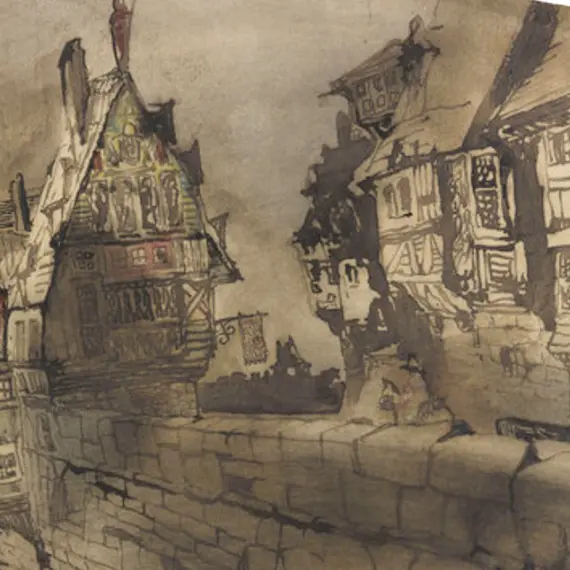
For the author of Notre-Dame de Paris, the Middle Ages were obviously a major inspiration. His work is filled with spectacular castles, massive and gaunt, cities with winding streets bristling with bell towers and towers, dark and strange ruins, and fantastic and frightening creatures.
To capture this period, which he and others were helping to rediscover after two centuries of silence, Hugo used a dark style, mixing ink washes, charcoal and black pencil, and giving his compositions that mysterious, eerie and poetic aspect that suited the Romantic spirit.
Perhaps less well known is Hugo's aptitude for drawing. Yet he took an early interest in this art, at first to record everyday memories or to make 'notes' that could help him in his literary creation. But very soon the graphic work became a creation in its own right, able to accompany his writing, express his convictions and develop his imagination.
For the author of Notre-Dame de Paris, the Middle Ages were obviously a major inspiration. His work is filled with spectacular castles, massive and gaunt, cities with winding streets bristling with bell towers and towers, dark and strange ruins, and fantastic and frightening creatures.
To capture this period, which he and others were helping to rediscover after two centuries of silence, Hugo used a dark style, mixing ink washes, charcoal and black pencil, and giving his compositions that mysterious, eerie and poetic aspect that suited the Romantic spirit.